Inside Evora’s Chapel of Bones: Portugal’s Most Haunting Landmark

I arrived in Évora, Portugal, at 4 a.m., stepping off a night bus from Spain into the cold, empty streets. My hostel? Nowhere to be found. After two hours of wandering the pre-dawn maze of cobblestones, I finally located it – only for the door to go unanswered.
I’d told them I’d arrive around 6 a.m., and even with my accidental detour, I was on time. But with no one opening up, I gave up and checked into a nearby hotel instead – one I’d already passed three times, where the night clerk had kindly tried to give me directions (it was a prehistoric time before Google Maps!)
Speaking of which: Check out this hotel if you want high-quality, affordable accommodation close to the center and the chapel itself.
I stayed four nights in Évora, a town most travelers might give two at most, because I like to take it slow, and I don’t regret it. I sampled the food, went out for drinks, and enjoyed the relaxed, slow-paced life and the quiet charm of the place. But I saved my main reason for being here – the Chapel of Bones aka Capela dos Ossos – for last. And today is the right time to talk about it!
A Rainy Morning and an Unexpected Guide
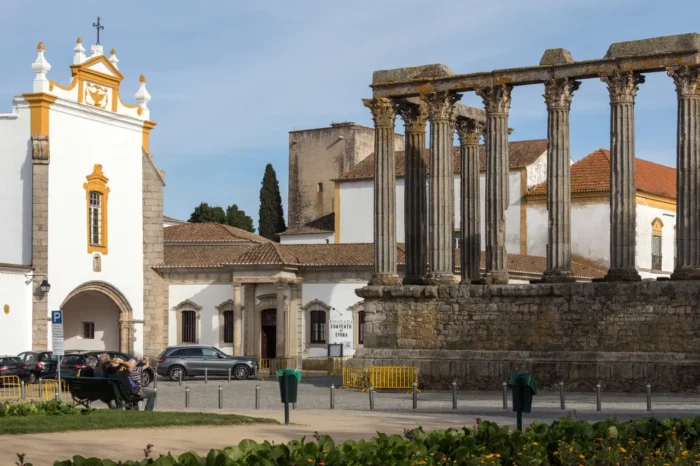
The day I set out for the chapel, it was raining. A large, shaggy dog followed me for several blocks, tail wagging despite the downpour. I, on the other hand, was wet, cold, and mildly disheartened. Eventually, the rain eased, and my canine companion wandered off in search of someone carrying snacks.
Stopping to admire a particularly striking building, I snapped a photo with my old point-and-shoot. A man got out of his car and, in crisp English, asked:
“You like Portuguese architecture?”
“Of course,” I replied.
He turned out to be a retired architect and, right there in the rain, gave me a brief walking tour of the surrounding area, naming the designers of the buildings with pride. We chatted for a while before he returned to his car, and I continued toward my destination.
(He hadn’t shown me the houses built under the aqueduct, but they’re worth seeking out if you’re in Evora.)
You might not be as lucky as I was to meet an amazing guide on the spot. Instead, I recommend booking this private tour with tickets included. This covers the Chapel of Bones, but also all the main attractions in the old town area (like the Cathedral, Roman Temple, and all the goodies in between). Highly recommended!
Entering the Chapel of Bones
By the time I arrived, I was drenched. I bought my ticket and the small photography permit, then stepped inside. The entrance greets you with a poem – translated here in full:
Where are you going in such a hurry, traveler?
Stop… do not proceed;
You have no greater concern
Than this one: that on which you focus your sight.Recall how many have passed from this world,
Reflect on your similar end;
There is good reason to reflect
If only all did the same.Ponder, you so influenced by fate,
Among the many concerns of the world,
So little do you reflect on death;If by chance you glance at this place,
Stop… for the sake of your journey;
The more you pause, the further on your journey you will be.
Walking to the far end, I froze: a full human skeleton hung there. I took a few photos, stepped back, and suddenly became aware of the room around me. The walls were covered, floor to ceiling, with human bones. I was alone, and the weight of the place hit me all at once.
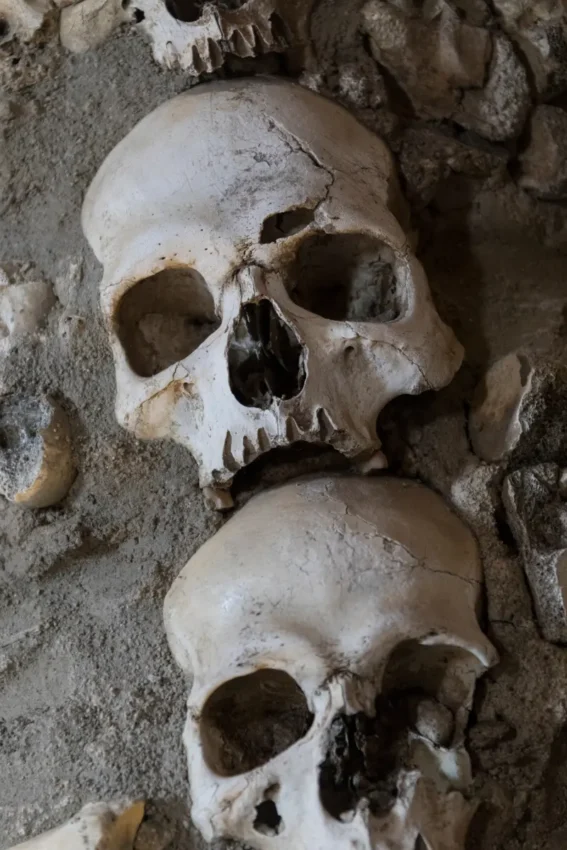
It really can’t be put in words. The eerie feeling that you get walking through the Chapel of Bones. Knowing that all the architecture, everything around you, used to be living human beings. It’s chilling and scary and awesome at the same time, and you can’t help but stare at the walls and all those bones, feeling something I can only describe as a pressure that pushes down on you – one you can only understand when you are there, experiencing this thing on your own.
I was starting to feel like in a crazy horror movie: everything was completely silent, the pressure was palpable, the bad thing about to happen.
Then – BANG!
A French family burst in, the parents flustered, the children wide-eyed. I laughed at myself for jumping, but only after I caught a few breaths. Then I stared at more bones.
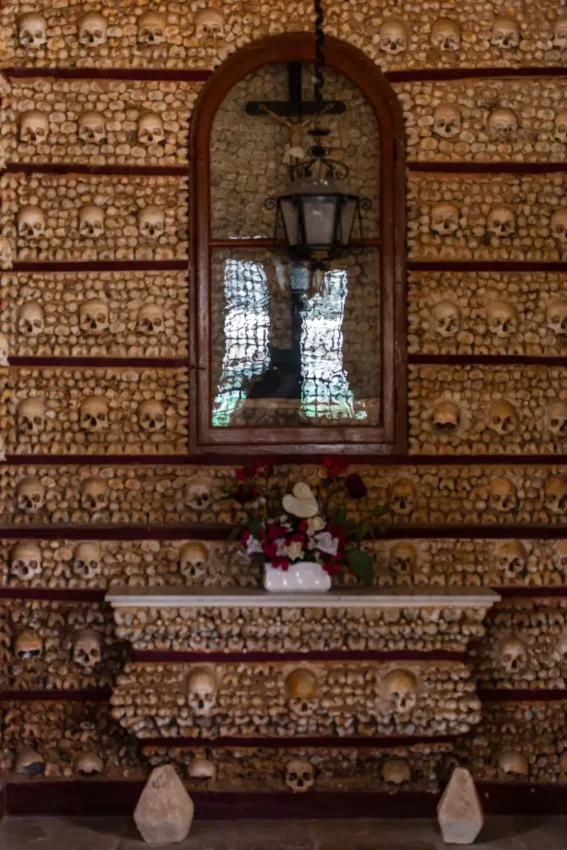
The chapel’s walls and pillars display bones from an estimated 5,000 people. Franciscan monks arranged them in the 16th–17th century when graveyards overflowed, aiming to nudge visitors toward reflection on life and death. Above the entrance, you’ll also find the stark inscription often translated as “We bones that are here, await yours.” Creepy!
Practical Info: hours, tickets, what your ticket covers
I like knowing the basics before I queue. The Chapel of Bones sits inside Igreja de São Francisco on Praça 1º de Maio (here).
It opens daily 9:00–17:00 in winter (Oct–May) and 9:00–18:30 in summer (Jun–Sep).
Ticket prices:
- Adult ticket €6
- €4 for people under 25, over 65 and those with disabilities (and their companion)
- €15 for a family ticket
- FREE for children under 12
Your ticket also includes the Chapter Room and Nativity Scene in Evora, the Sacred Art Museum Center and the Royal Tribune Room, the Multimedia Room, Galilr Terrace and the Canha da Silva Nativity Scene Collection. The church itself is free to enter, but it’s the chapel you HAVE to visit.
I highly recommend getting the guided tour, though, if you want to learn more about the chapel and visit all the attractions in the area. Check it out here.
More to See in Évora
I also visited the Roman ruins you can see in the photo above – an aqueduct, an old forum. I’ve seen plenty across Europe, but I still enjoy seeking them out. Even so, nothing in Evora compared to the Chapel of Bones. Standing there, surrounded by the remains of thousands, forces you to confront your own mortality in a way few places can.
Still, there are things that should be seen since you’re here, especially since they’re all within walking distance:
- Roman Temple of Évora (Templo Romano): a 10–12 minute walk from the chapel.
- Sé Cathedral: climb for roof views if you’ve got the legs.
- Aqueduct houses on Rua do Cano: homes tucked between the granite arches – quirky and photogenic, perfect for a short walk. You will discover something interesting, guaranteed, after each corner or unexpected turn.
Old-town cobbles and narrow passages can be tricky. Charming, but tricky if you’re not in your best shape. Evora offers workable, accessible routes across the center, but some heritage interiors have steps and tight corridors. Bring support if needed and ask staff for the easiest path.
And, before you go, make sure to read my article about Portuguese culture.
If you’ve been to the Chapel of Bones or a place like it, would you recommend it? What travel experience has left the deepest mark on you? Let us all know by sharing your thoughts down below!