Minimum Wage in the EU 2026: Full List of Countries, Net Take-Home & New Transparency Rules

I have been tracking minimum salaries across the European Union for several years now, and sharing them here on this very article, but I’m still taken aback by the stark differences in wages across the continent. Just when you think the gap is closing, inflation or tax changes widen it again.
If you are planning a move, eyeing a career change, or just curious about the economic reality of the bloc – or just a specific country within the EU – knowing these numbers is the least you need for understanding your potential quality of life.
I have an in-depth analysis and opinions to share, specifically regarding the massive changes we are seeing in 2026, including Bulgaria finally adopting the Euro and the upcoming Pay Transparency Directive.
But if you are here just for the data, the table below is what you need to understand the current minimum monthly salaries in the EU.
Minimum Monthly Wages in European Union Countries (in 2026)
With all the context in mind, let’s look at the minimum salaries in the European Union (per month), ranked from the highest to the lowest.
Important 2026 Update: While I previously focused solely on Net (take-home) pay, I am now including Gross figures where necessary. Why? Because tax brackets have shifted drastically in countries like Germany and Ireland this year, and “Net” varies wildly depending on if you are single, married, or have children.
The list below reflects the estimated Net Take-Home Pay for a single person with no children as of January 2026.
| Rank | Country | Estimated NET Salary |
| 1. | Luxembourg | €2,250 |
| 2. | Netherlands | €2,200 |
| 3. | Ireland | €2,100 |
| 4. | Denmark | €2,050 |
| 5. | Belgium | €1,850 |
| 6. | Sweden | €1,600 |
| 7. | Germany | €1,515 |
| 8. | Austria | €1,510 |
| 9. | France | €1,425 |
| 10. | Finland | €1,390 |
| 11. | Italy | €1,100 |
| 12. | Spain | €1,035 |
| 13. | Slovenia | €900 |
| 14. | Portugal | €890 |
| 15. | Malta | €870 |
| 16. | Cyprus | €866 |
| 17. | Greece | €860 |
| 18. | Poland | €855 |
| 19. | Lithuania | €855 |
| 20. | Estonia | €810 |
| 21. | Croatia | €780 |
| 22. | Czechia | €760 |
| 23. | Latvia | €660 |
| 24. | Slovakia | €660 |
| 25. | Romania | €552 |
| 26. | Hungary | €529 |
| 27. | Bulgaria | €481 |
A Note on the “No Minimum Wage” Countries:
Please keep in mind that countries like Austria, Denmark, Sweden, Italy, and Finland do not have a single national minimum wage set by law.
The numbers above are my best estimates based on the lowest pay scales in major Collective Bargaining Agreements (CBAs) for 2026. In these nations, unions are strong, and you rarely find jobs paying less than these figures, even without a government mandate.
If we look at the average minimum salary across the European Union, the math gives us a snapshot of the economic health of the continent.
Average minimum salary in the European Union in 2026: €1,161 / month (Net Take Home)
I am tracking this since 2020 now, and below you can check the evolution of the average minimum salary in the EU for all countries and how much it has grown compared to the previous year.
| Year | Average minimum EU salary |
|---|---|
| 2020 | €806/month |
| 2021 | €867/month (+7.5% vs previous year) |
| 2022 | €902/month (+4.03% vs previous year) |
| 2023 | €979/month (+8.53% vs previous year) |
| 2024 | €1,058/month (+8.06% vs previous year) |
| 2025 | €1,149/month (+8.60% vs previous year) |
| 2026 | €1,161 / month (+0.95% vs previous year) |
2024 became the year when the average minimum salary across the EU passed the €1,000/month mark, but it’s obvious that salary growth slowed down a lot this year.
It’s interesting to note that just 10 countries of the 27 earn more than the average minimum salary throughout the Union, with Bulgarians making €680/month less than the average.
However, all these numbers need to be taken with a grain of salt. Even though the lowest minimum salary (Bulgaria) is almost 5 times lower than the maximum minimum salary (Netherlands), the cost of living in each country is also different and mostly keeping a similar ratio.
2026 Milestone: Bulgaria Joins the Euro Club
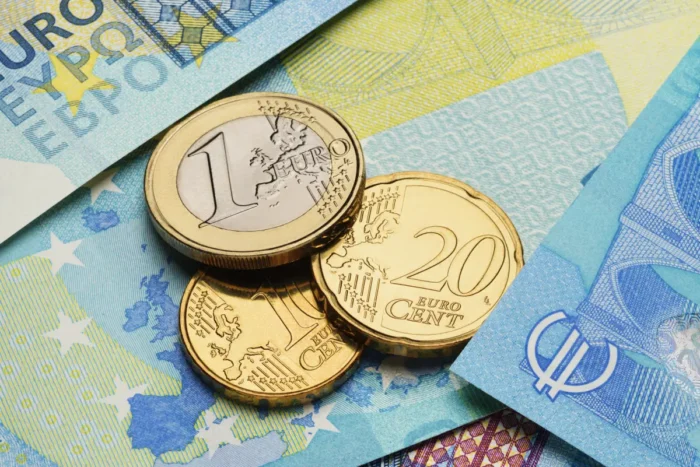
The biggest change affecting this list in 2026 is Bulgaria. As of January 1st, Bulgaria officially adopted the Euro.
Previously, tracking Bulgaria’s wages meant constantly converting from the Lev (BGN). Now, the minimum wage is legally set in Euro.
While they are still at the bottom of the list with approximately €480 net, the adoption of the Euro is expected to accelerate wage convergence with the rest of the EU over the coming years. Prices will likely stabilize, and investment may increase, hopefully driving that minimum number up faster than before.
Why It’s Important to Know the Minimum Salaries Across the EU Countries
Knowing the minimum wages should be extremely helpful in showing which countries are the cheapest to live in the European Union and where you can expect to earn more for the same amount of work.
However, for most countries, earning the minimum wage wouldn’t be enough to afford a good life – or even a decent one.
For example, earning €4200 in Bulgaria, €517 in Romania, or even €720 in Czechia wouldn’t be enough… although once we get to values close to or over €1,000/month, you can expect to be able to live at least decently.
But overall, knowing the minimum salaries in each country helps you better understand and estimate living costs and the quality of life in each. And also shows the huge discrepancy that’s still present in the Union.
The “Transparency” Revolution Coming in June 2026

There is another massive shift happening this year that you need to know about. The EU Pay Transparency Directive must be transposed into national laws by June 2026.
This is a game-changer for anyone looking for a job in the EU.
- No more secrets: Employers will be required to provide information about the initial pay level or range in the job vacancy notice or before the job interview.
- Salary History Ban: Employers will no longer be allowed to ask you how much you earned in your current or previous job. This is huge for breaking the cycle of low wages, especially for migrants moving from lower-income EU countries to higher ones.
This means that while the minimum wage is a legal floor, the actual offered wages are about to become much more visible and negotiable.
Countries with the Lowest Salaries in Europe
The countries bringing up the rear in 2026 are still Bulgaria, Hungary, and Romania.
There is a gap of nearly €1,800 between the lowest earner in Bulgaria and the highest in Luxembourg. There were talks in the European Union leadership about introducing a uniform minimum wage, but a recent court ruling and economic reality have slowed that down.
The EU now focuses on ensuring minimum wages are “adequate” relative to the country’s own poverty line, rather than forcing a single number across the bloc.
With variations as high as those you see above, a single minimum wage is impossible to implement right now.
But overall, these values should be as close to reality as possible and paint a picture that’s as clear as possible regarding minimum wages in the European Union.
They can help you choose a home base in Europe that is perfect for cheap travel in the area.
For a better understanding of how much is enough to live in a specific country, I have written an article on the average wages in the EU so you should check that out as well after finishing reading this one.

Wrapping up
With inflation stabilizing but prices remaining high, salaries kept growing in 2026, although at a much slower pace compared to previous years.
It is obvious that traveling to or moving to Bulgaria, Hungary or Romania (or any of the countries towards the bottom) is a lot cheaper than visiting or moving to Luxembourg, Denmark or any of the top ranked ones – even though the salaries are higher also.
To help you make better decisions regarding your future, you know know the minimum monthly salaries in the countries of the European Union.
If you live in one of these countries and you notice that the actual values that I have quoted are wrong, please let me know so that I can correct them ASAP – it’s very, very difficult to gather all the data from official, trustworthy sources and sometimes they are years old!
My sources for this article include Wikipedia, Croatia Wise, Romania Experience, as well as various other local websites, including research I did for other articles here on Nomad Not Mad.