The Insider’s Guide to Finnish Culture

Finnish culture is all about letting you say and do whatever you please, generally. The people are kind and liberal, even more than you probably expect from people who spend half the year in darkness.
There is a lot to learn about Finnish culture, though, and we’ll get more in-depth in today’s article. We’ll start with the number one lesson that you should know:
Don’t worry too much about it!
As a foreigner, you get a kind of a free pass when it comes to Finnish culture and customs. There is very little chance that you actually offend anyone no matter what you do.
That being said, whether you are taking a quick trip or you are planning to move to Finland, knowing the quirks people have is always a good thing.
This way, you would avoid the culture shock and have a much smoother experience. Hence, my in-depth guide to Finnish culture below (which is kind of long overdue, too).
The Myth Of The Cold Finn

Finland is way up in the North. Go look where Helsinki is on a map, and you’ll see what I mean. And when you get back, read my article about the top things to do in Helsinki to be surprised.
Back to today’s topic, the cliché is that Nordic people are about as warm as their climate.
Although that might kind of still hold true, it depends on what you are comparing them to and even more importantly, what your definition of “cold” is.
Here is the thing:
Americans and some Western Europeans are very big on small talk. Chatting up a stranger or a near stranger (like your neighbor, work colleague, or a friend of a friend) is normal and even desirable.
If you keep to yourself, you are perceived as cold and unfriendly. If that is your mindset then yes, Finnish people can come across this way.
But consider this Finnish proverb: Take a man by his words and a bull by its horns.
Finns consider very carefully what they say and mindless banter just to fill the silence is anything but cool. You would notice how comfortable people are with silence.
That being said, if you appear to be lost or need help, they would be quick to ask what’s wrong and offer assistance. Hospitality is one of the most amazing traits of Finnish people.
By the way, going back to that proverb, it also means that promises, even ones you gave lightly, are taken very seriously.
For instance, you would probably think nothing of saying, ‘Yeah, we should hang out sometime,’ to a friend whom you have no intention of hanging out with anytime soon. Don’t do it. Finnish culture is as straightforward as it gets.
So I would say the only really cold thing in Finland is… the weather. Which can be considered nice, in the end, once you adjust and if you’re not like me, a summer & warmth lover.
Speaking of cold weather, make sure to read my previous article on how the Finnish people celebrate Christmas and the winter holidays.
Finland’s Language (A.K.A. Will They Understand Me?)
The mother tongue of most Finns is, unsurprisingly, Finnish.
Around 5.6% have Swedish as their first language and there is also Saami (one of the oldest languages in Europe) with around 8,000 speakers. Finnish is nothing like other languages in the region.
It belongs to the Finno-Ugrian language group where Hungarian and Estonian also belong. It does have some words that come from English or French but other than that it is completely different.
You would not be able to make out what any words mean, I can guarantee that.
Most Finns also speak pretty good English, as well as Swedish. Swedish is also the second official language of the country (and the only official language in the Åland islands) and you get all street signs in both Finnish and Swedish.
Unlike Finnish, Swedish is a North Germanic language. You could kind of figure out what signs in Swedish say.
Ultimately, though, you would probably have no language issues in the first place.
Finnish culture puts a lot of emphasis on education. As I mentioned, most Finns are tri-lingual and some even speak four or five languages.
There is a growing number of Finns who learn German or French, while Spanish is yet to become as popular.
In general, though, provided that your native language is a fairly popular one, you would not have problems finding Finns who speak it. It is one of the fun aspects of the education system they have.
And yes, this means that if you speak English, you will be mostly covered in Finland: everybody will understand you.
Food And Eating Habits

I think that, in every country, food says a lot – and this surely holds true for Finnish food & culture.
Breakfast is the most important meal of the day and it can be quite taxing on your arteries, too. It usually involves open sandwiches with a substantial amount of butter on them. The toppings aren’t very diet-friendly, either.
Hard cheeses are a massive favorite, and so are thick cold cuts. Make sure you also try typical Finnish porridge/oats. Hint: it has a lot of butter and usually some lingonberry or strawberry jam.
This makes sense, though. Traditionally (aka “back in the day”), people needed all these high-calorie foods in order to have enough energy throughout the day.
You burn a lot more calories when you have to work in the freezing cold weather. And back then, extreme physical work was the norm.
After breakfast, it’s soon time for the coffee break.
Finns consume the largest amount of coffee per capita in the world. Coffee breaks are inevitable and they are usually the best time to make friends with your colleagues.
Don’t expect decaf to be an option and don’t let the five cups per day most Finnish people have shock you.
If you can’t handle it, stick to the cinnamon rolls or buns that accompany the coffee.
Lunch and dinner both happen pretty early, with lunch being served between 11.00 and 13.00 and dinner around 17.00 to 19.00. If you want to grab a bite after work, you’d better hurry.
Finnish culture embraces work-life balance and that holds true for restaurant employees as well. Most establishments wrap up the evening rather early and they stop serving food around 45 minutes to an hour before they close. It would be best to make your dinner reservations for 18:30 or 19:00 at most.
Restaurants that serve foreign cuisine tend to close later, but you are here for the Makkara (pork sausages), the salmon, and the awesome variety of cheeses, right?
I have a more in-depth article on the traditional Finish foods you should try – make sure to read it after you’re done reading this one.
Finnish Culture: National Pride And Identity
As open-minded and liberal as the Finnish might be, they are still very much patriotic. It’s a weird situation, too.
On the one hand, they are very appreciative of foreign culture, and they take pride in accepting others, in multiculturalism, if you will. On the other hand, they have a very strong sense of national identity.
There is one sure way to a Finns heart and that is knowing about their history or sporting achievement.

If you also happen to have read some Finnish classics or seen some of the staples of Finnish cinema, even better. Here are a few pointers:
– Frans Eemil Sillanpää got the 1939 Nobel Prize in Literature. So far, he is the only Finn to receive the award.
Since his work is centered around what is quintessentially Finnish (he won ‘for his deep understanding of his country’s peasantry and the exquisite art with which he has portrayed their way of life and their relationship with Nature‘), it would be a great perspective of Finnish culture for you, even as a foreigner.
– Paavo Nurmi and Lasse Viren are Finnish runners and Olympic gold medal winners. Know their names at least and Finns would love you.
– Know about Finland’s independence struggles against Sweden and Russia. It is the historical reason for the Finnish national pride. Their nation has had to fight long and hard to become a separate state.
Along with the sense of identity, though, you also have this chronic fear of not being known. It is like being the wallflower in high school but on a national level.
They expect Finnish culture not to be known by foreigners and that is why it’s so easy to impress Finns even with the most basic of knowledge about their country.
Finland, the Mechanics of Sisu and Happiness
In 2026, Finland was named the happiest country in the world by the World Happiness Report for the ninth consecutive year. You would never guess it by looking at their stoic faces on the Helsinki tram.
This happiness does not stem from walking around with a permanent, idiotic grin on your face, though. It is rooted in a deep-seated institutional trust, a complete lack of corruption, and a societal safety net that allows people to actually breathe and be less stressed than most people worldwide. And that means – you get to realize as a grown up – a lot.
At the core of this mindset is the concept of Sisu.
There is no direct English translation for Sisu, but it roughly equates to a mixture of extreme resilience, determination, and inner strength.
It is the psychological fuel that gets Finns through agonizingly long winters and historical wars with massive neighboring empires.
In other words, you just put your head down and get the job done when things look entirely hopeless and enjoy the full happiness afterwards.
Speaking of happiness and amazing things, make sure to check out my recommended day trips from Helsinki.
The Finnish Sauna
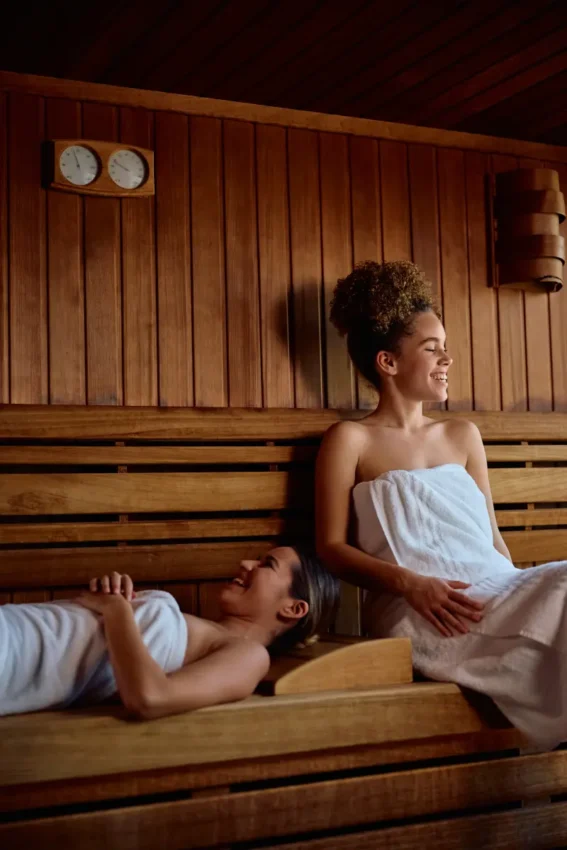
This might sound like a stereotype, but the truth is that the Finnish sauna is similar to what pizza or pasta are to Italy. In other words, the sauna is practically a religion here and is officially recognized on the UNESCO Intangible Cultural Heritage list.
There are over three million saunas in a country of five and a half million people, so we can safely say that there’s at least one for each Finnish family. You will find them in apartments, corporate boardrooms, and isolated lakeside cabins alike.
This is where the famous Finnish social ice finally melts. The rules are simple but strict: you leave your clothes and your ego in the changing room. You do not wear a swimsuit unless specifically told otherwise by the host, and you definitely do not bring your phone!
Sitting naked, sweating in a wooden box with complete strangers is the ultimate equalizer. It is where Finns socialize, relax, and drop that famously cold exterior. If you get invited to a sauna, you say yes.
The Finnish Welfare State
Being a welfare state is not a bad thing in the eyes of Finnish people. The country currently has one of the best, most generous social security systems in the world.
It hit a high point in the 80s and they have had to make cuts since but Finland still takes good care of it’s citizens.
Not all of it is good, though.
Many young people are unmotivated and often plain lazy. True, they get a good education but they aren’t very entrepreneur-minded.
The consequence you see on a day-to-day basis is that you would not impress anyone by how much you earn.
As cliché and unbelievable as it may seem, everyone is rich in Finland. The country is very expensive, too and the cost of living in Finland is rising steadily. But, for now, everything works flawlessly there the way it is.
Wrapping up
That’s a wrap on our article about Finnish culture. By now, you should know all the important things about it and you’ll be ready to impress your Finnish friends with your knowledge.
If there’s anything else that you feel should be added here, let us all know by commenting below.